
Loading...
Loading...
Retirement income planning has evolved rapidly over the past decade. What was once a niche capability, focused primarily on Social Security timing or basic withdrawal sequencing, has expanded into a complex, multi-dimensional problem requiring coordination across taxes, investments, income sources, and client behavior.
Today, advisors and institutions have no shortage of tools to choose from. But not all retirement income solutions are built the same, and the differences matter.
In this post, we look at the broader landscape of retirement income planning tools, before outlining what differentiates a next-generation approach.
Examples: eMoney, MoneyGuidePro, RightCapital
These tools rely on Monte Carlo simulations and “what-if” comparisons:
They are flexible, but place the burden on advisors to determine the best strategy for the client.

Examples: Income Lab, Income Conductor
These tools introduce structure through guardrails or time-segmentation approaches, stress testing strategies and income-focused outputs
However, they often:
Examples: Covisum, LifeYield
These focus on specific areas like:
But they don’t solve the full retirement income problem on their own.
Across categories, most tools treat retirement income planning as a series of separate decisions, not a single, integrated problem.
That leads to:
Income Discovery was built to address this exact challenge.
Rather than modeling individual strategies or relying on scenario comparisons, it approaches retirement income as a unified optimization problem, solved holistically across all planning dimensions.
At its core is a fiduciary-grade optimization engine (AIDA), designed to:
Instead of optimizing one lever at a time, Income Discovery simultaneously evaluates:
This results in a single, cohesive plan—not a set of competing options.
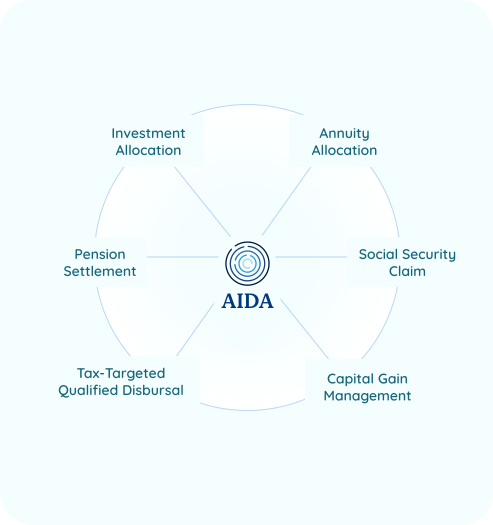
Most tools rely on fixed or rule-based withdrawal orders.
Income Discovery takes a different approach:
The result is a materially more precise and adaptive distribution strategy.
Income Discovery models retirement at a level of detail required by enterprise firms intending to execute the plan:
This enables more accurate projections and more reliable outcomes.
One of the biggest gaps in the industry is the transition from planning to action.
Income Discovery bridges that gap through Income Delivery:
This transforms retirement income from a static plan into an ongoing, managed process.
Rather than relying on periodic re-planning or guardrails alone, Income Discovery provides:
This creates a more stable and proactive retirement experience. Unlike other methodologies, it provides stability in spending by:
Many tools overwhelm clients with long reports, dense tables and complex statistical outputs
Income Discovery takes a different approach:
| Capability | Scenario-Based Tools | Strategy-Based Tools | Income Discovery |
| Approach | Compare scenarios | Apply frameworks (guardrails, buckets) | Full optimization across all variables |
| Optimization | Manual / iterative | Partial (by component) | Simultaneous, holistic optimization |
| Withdrawal Strategy | Rule-based | Semi-structured | Dynamic, tax-aware, account-level |
| Tax Strategy | Bracket-based | Simplified | Incremental effective tax targeting |
| Planning → Execution | Not connected | Limited | Fully integrated (Income Delivery) |
| Monitoring | Re-plan periodically | Guardrails alerts | Continuous (SafePath™ framework) |
| Client Output | Data-heavy | Strategy-heavy | Clear, actionable recommendations |
Income Discovery stands apart in a few key ways:
The retirement income space is rich with tools—but most fall into one of two camps:
Income Discovery represents a third category: a fully integrated, optimization-driven platform that connects planning, execution, and ongoing management into a single system.
For firms operating under fiduciary or Reg BI standards, and for advisors seeking to deliver consistent, scalable, and truly optimized retirement income strategies, the distinction isn’t just meaningful, it’s essential.
Sign up to stay informed about Income Discovery. Keep up-to-date on new features, releases, and products.
Get updates about new whitepapers, industry news, blog posts and more.